Did Love Never Dies Fail Because It Refused to Please?
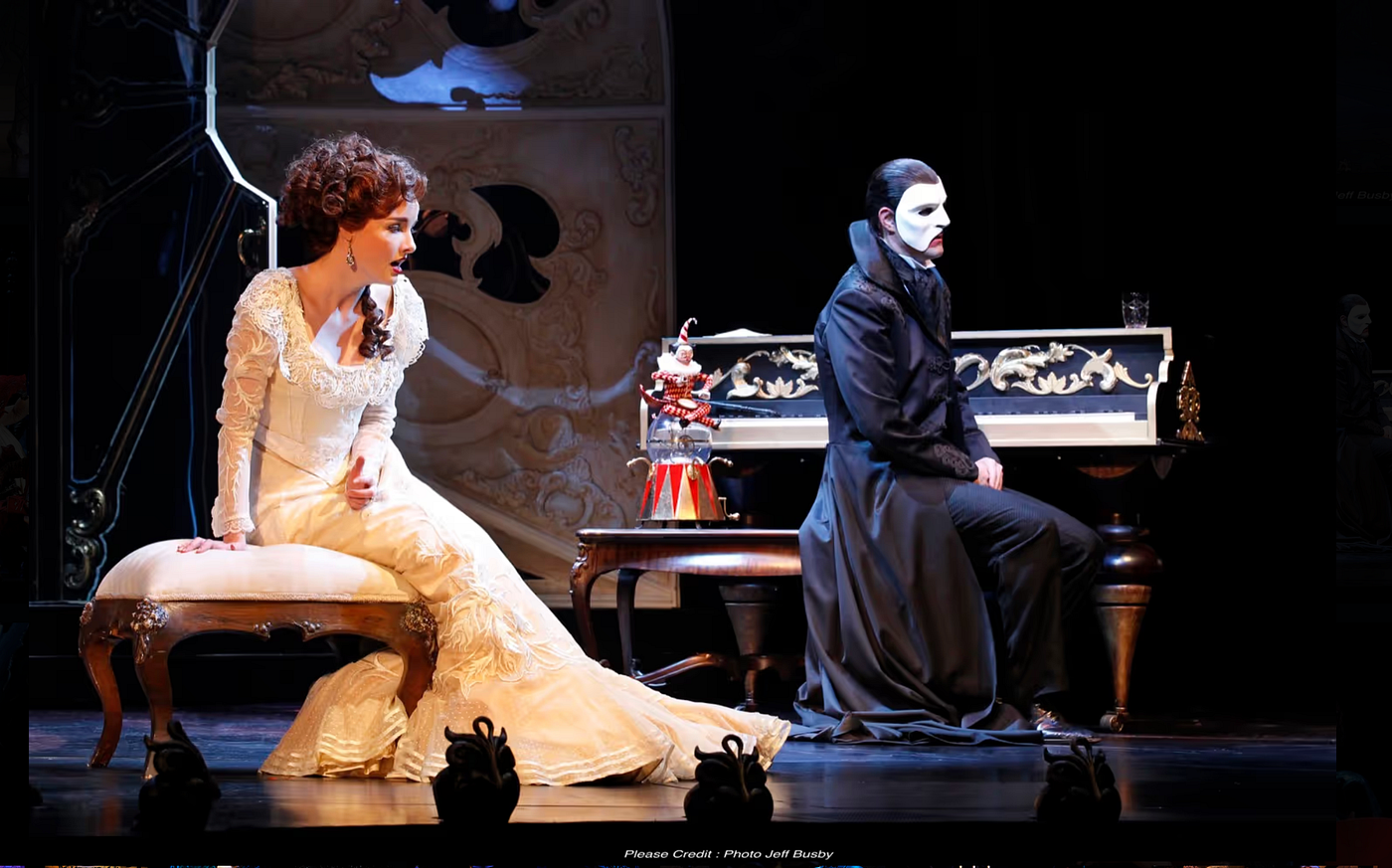
You probably have heard or watched Andrew Lloyd Webber’s The Phantom of the Opera before — either in a musical theater, a movie theater, or heard one or a few of its melodies on Spotify, or perhaps you still have the musical CD on your shelf?
Indeed, according to Broadway News, as of April 2023 The Phantom of the Opera is one of the most successful and enduring entertainment properties in history, having grossed over $6 billion worldwide and been seen by more than 160 million people in 213 cities across 58 territories. As a cultural phenomenon, it ran on Broadway for 35 years. The Phantom of the Opera is probably one of the most successful Broadway musicals in the world.
People were moved by the love triangle relationship among Christine, the Phantom, and Christine’s childhood sweetheart, Raoul. The story had a bit of a tragic ending. Christine fell in love with the Phantom, but when he kidnapped her, she got terrified. So the Phantom decided to set her free and disappeared. Christine and Raoul had a happy ending.
This was an enchanting story — pure love, melodic tones, passionate lyrics, and a monster who decided to let go.
Then, in 2010, Webber launched a sequel, Love Never Dies, which was not very popular. In fact, it received negative reviews when it premiered in London back in 2010.
The story is much darker than the first one. Ten years later, Christine, Raoul, and their son Gustav went to New York for a performance — the trip was set up by the Phantom. Christine’s and Raoul’s marriage was not as smooth as it seemed on the surface. Raoul became an alcoholic and did not want Christine to be successful in her career. Christine was just enduring everything until she met the Phantom again. She died in an accident and revealed that Gustav was the son of the Phantom.
The overall melody of Love Never Dies was very Webber — dramatic and grandiose — and it also carried the signature Phantom theme to position it as a sequel. A few transitions reminded me of Webber’s other blockbuster, Sunset Boulevard. There is nothing wrong with the melody or the lyrics; it’s the story that disappointed the theatergoers.
Because love, as defined by Love Never Dies, was very different from the expectation:
- The rich, handsome Raoul became a failed husband and father, suffering from gambling and alcoholism;
- The once innocent and naive Christine proved to have betrayed her husband for 10 years;
- The love-sick Phantom was a coward, as he left the girl he loved 10 years ago. He then spent 10 years building an acrobat-run-by-freaks show.
This is an adult version of romance that is difficult to catch the audience’s attention immediately, especially for those who had been immersed in the original Phantom of the Opera storyline.
I am sure Webber knew how to make a blockbuster story — he could easily change the plot and the characters. For example:
- Raoul could be as loving and kind as ever;
- Christine decided to be a good mother after her betrayal, therefore declining the Phantom with expressed confirmation;
- The Phantom could have plastic surgery and become a rich, successful businessman (like Jean Valjean of Les Misérables, perhaps?) and withdraw again, like last time.
But Webber did not make any changes to “please” the market.
On the contrary, he stuck to his storyline without considering the ticket box.
I admired his courage and honesty greatly. This is exactly the decision every artist faces when presenting his stories: “Should I do it for myself or for my audience?”
It’s a million-dollar question.
Many writers write for themselves, but when there is very little or almost no feedback or responses, they still feel a bit disappointed that few — or no — people resonate with them.
This is the loneliness that any creative writer must endure.
Salute, Mr. Webber!!


Comments
Post a Comment