What Living Under a Volcano Taught Me About Starting Over
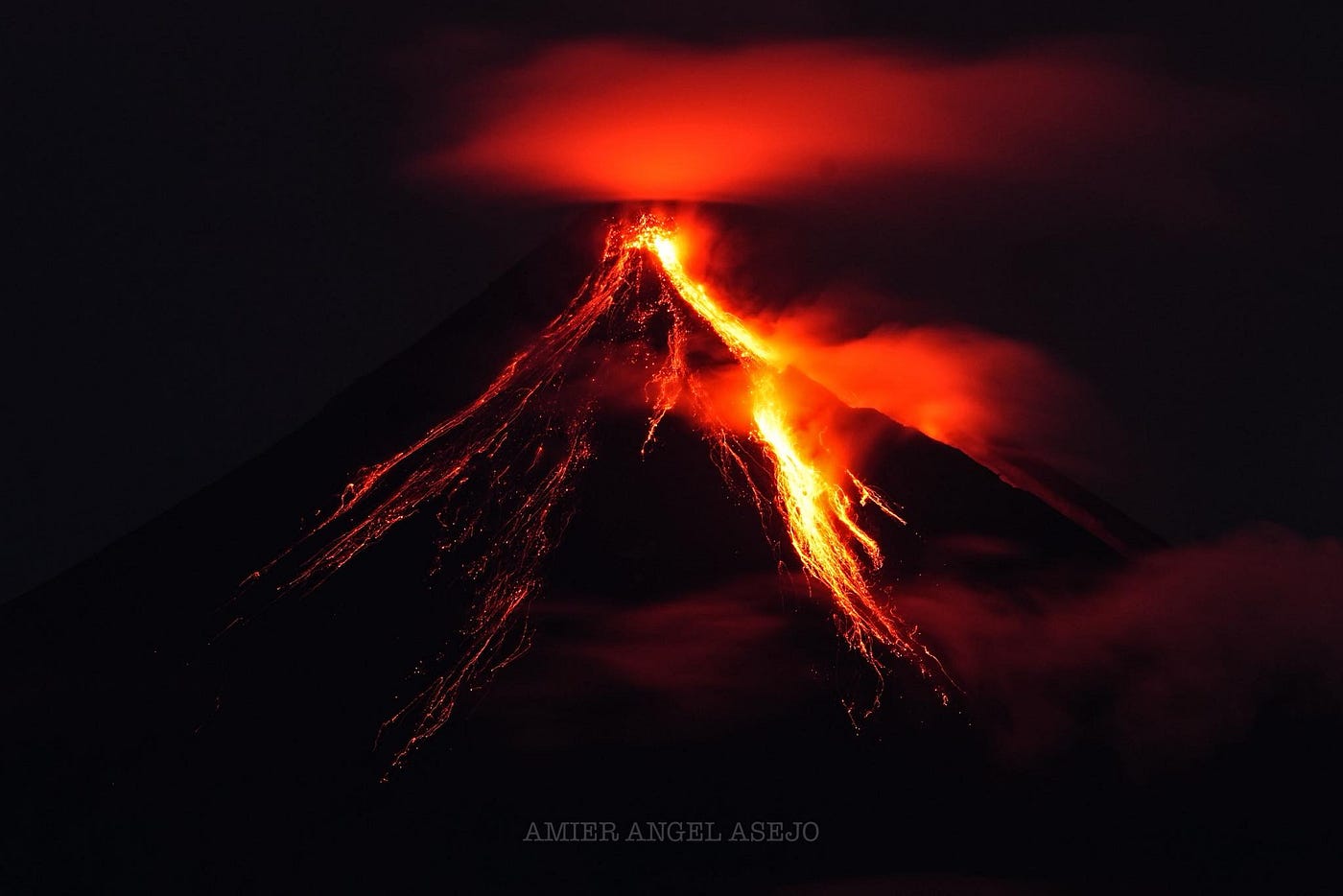
Mayon Volcano has been erupting for months. This round started in January 2026. I watched the news online from time to time. I asked my friends in Legazpi, where Mayon is located, and they reassured me not to worry.
“Everything is okay,” they said.
Indeed, compared with 2018 — the first time I experienced a Mayon eruption from my house in downtown Legazpi City — I was stunned. At first, it was the beauty of the eruption: the lava flows at night and the thick smoke in the daytime, viewed from a distance, were impressive. Later came the immersive inconvenience of daily life:
Flights were cancelled with no confirmed resumption schedule because the airport — which was then still quite close to the volcano — was closed during the eruption.
Depending on the direction of the wind, volcanic ash fell over different parts of the neighborhood and brought never-ending house-cleaning work.
Then came the fear of possible lava landslides whenever there was a heavy rain warning, because lava flows combined with heavy rain had already caused devastating landslides and killed people before.
ource: afarTV www.youtube.com/@afartv
But today, I suddenly realized something:
A volcano interrupts life, but it also restores life afterward.
A volcano brings disruption. It destroys order. It interrupts life. It burns, breaks, and changes the landscape beyond repair. No one welcomes an eruption while it is happening. No one stands in the ash and calls it a blessing.
And yet, when lava cools, it becomes fertile ground. What was once violent becomes the basis for new growth.
The same force that destroyed the old landscape later nourishes life.
I think that is why I was sent to live under Mayon Volcano — more precisely, about 15 kilometers from its crater — into a life far removed from the structure, comfort, and familiarity I had known in Hong Kong.
Not because adapting to an entirely different lifestyle there was easy. Not because the disruption was good. And certainly not because I should romanticize what happened.
But because I needed to understand disruption from the inside.
I needed to know what it feels like when life stops being what I thought it was supposed to be: when the ground shifts; when hope, love, and trust become entangled with endurance; when a chapter of life turns into something I would never have chosen for myself had I known the truth then.
That was the eruption.
And now, perhaps, I am in the phase after the lava has cooled — or is cooling.
I do not mean that everything is healed. I do not mean the past has become acceptable.
I still reject much of what happened. I still wish that chapter had never existed.
But I can also see that the terrain it left behind is not the same as before.
I am not the same as before.
Something in me now sees things differently.
I understand power, deception, disruption, and moral contradiction with greater clarity. I no longer trust surfaces so easily. I no longer mistake ritual for truth, or authority for integrity.
And perhaps most importantly, I now know that life can return even after devastation — though it returns in a different form, one I never imagined at all.
This, perhaps, is the beginning of my new life.
Not a return to the old one.
Not a repair of what was broken.
But growth from altered ground.
The eruption was not the purpose. However, the ground it left behind may still be usable.
And if that is true, then perhaps Mayon was not only a place of loss. Perhaps it was also the place where I learned, painfully and unwillingly, that something must die before a more resilient self can emerge.
Maybe that is why I was there.
Not to remain in ash forever, but to one day understand what it means for life to grow again.
I would never have chosen the eruption. But I no longer see it only as destruction. In its own harsh way, Mayon altered the ground. For that, I am grateful.


Comments
Post a Comment