When Rules Stop Constraining Power
For decades, the international system operated on a shared understanding, at least among members of the United Nations: power, however unevenly distributed, was still expected to remain within certain boundaries. Sovereignty could be violated, but it required justification. Force could be used, but it demanded explanation. What has changed recently is not the demonstration of power itself, but the expectation that it must still be constrained — or even plausibly defended — by law.
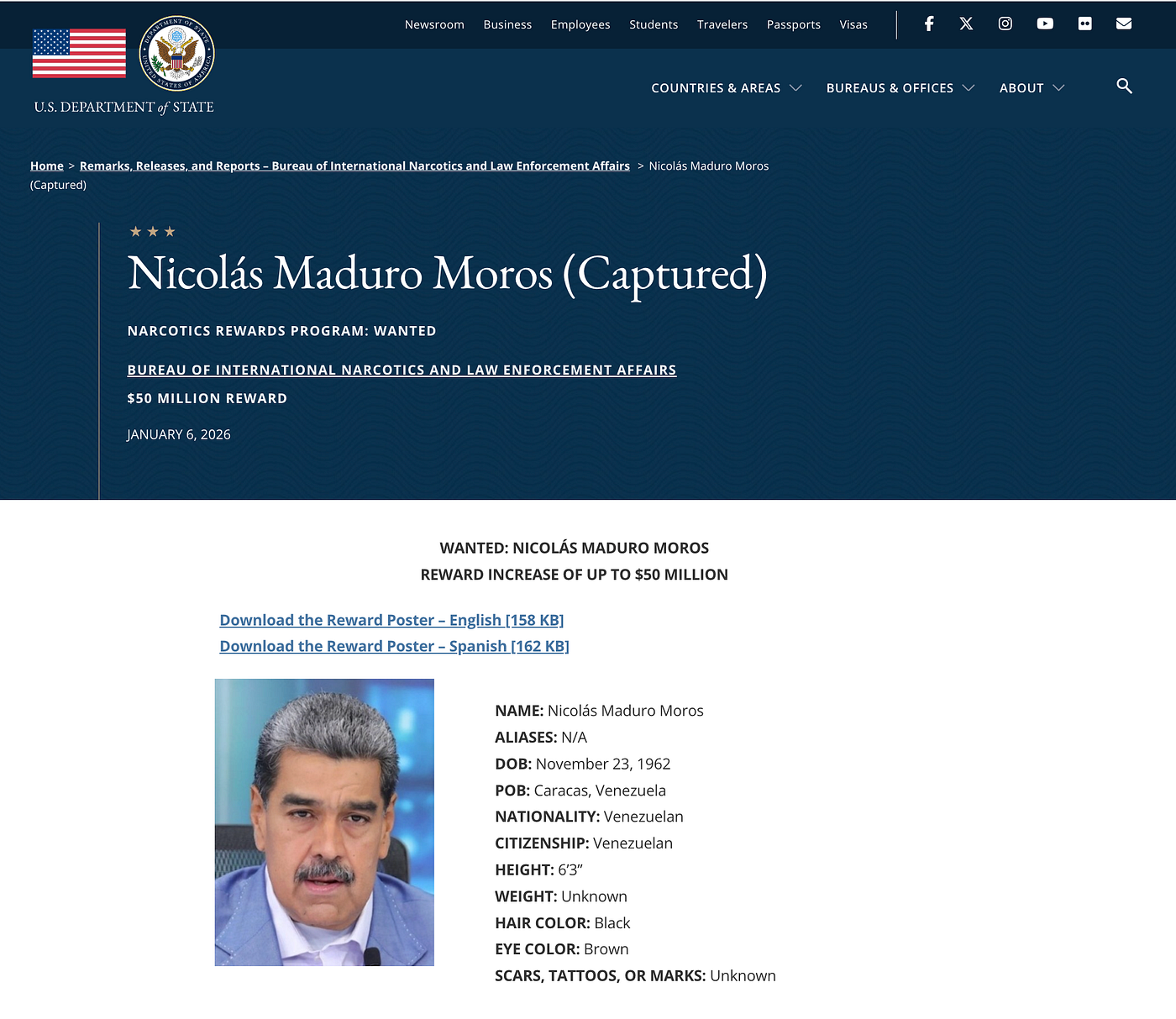
A post on the U.S. Department of State’s website says everything.
The United States listed another country’s president, Nicolás Maduro Moros, as a wanted person under the Narcotics Rewards Program. The case is now closed — captured.
From the State Department’s perspective, the Venezuelan (former) president is treated no differently from other drug lords residing outside the United States. Framed this way, the operation can easily be described as part of an “anti-drug” campaign.
But was it?
Maduro was the commander in chief of a sovereign state when the U.S. president announced his capture and stated, “We are going to run the country.” At that point, the action had clearly moved beyond the scope of any anti-drug operation. What was presented as law enforcement began to look like something else entirely.
A simple comparison helps clarify why this matters. Imagine if Vladimir Putin were to send 150 aircraft — including bombers, fighter jets, and reconnaissance planes — to airstrike Kyiv, capture President Zelensky, and then claim it was merely part of an anti-drug campaign, arguing that Zelensky was an outlaw anyway. If such a case were brought to the UN Security Council, the United States would almost certainly be among the first to propose sanctions against Russia.
The contrast is revealing.
I found the name Operation Absolute Resolve particularly striking.
To “resolve” means to end something. What appears to have been resolved here, I think, is Article 2(4) of the United Nations Charter, which states:
“All Members shall refrain in their international relations from the threat or use of force against the territorial integrity or political independence of any state, or in any other manner inconsistent with the Purposes of the United Nations.”
A president of one state was captured and extradited to another state. This action directly disregards the principles set out in the Charter. And yet, inside UN meeting halls, there were only discussions and expressions of concern. Members of the Security Council remain divided. Nothing followed.
In truth, condemnation and sanctions have rarely produced meaningful results for years. Perhaps this time is no different — or perhaps it is simply more explicit. At the very least, a few things are now clear.
First, saying something is one thing; acting is another. When the United States accused Russia of invading Ukraine and violating its sovereignty, the charge rested on the assumption that territorial integrity still mattered as a rule. Now, the United States has demonstrated something even more striking: entering another country’s territory and extraditing its leader, regardless of how infamous that leader may be.
Second, the old rules no longer seem to function as they once did. The United States was a founding member of the United Nations and once helped support many developing and underdeveloped countries. That United States feels increasingly distant. What remains is a country that no longer hesitates to display its military power openly, or to state plainly what it intends to do.
Finally, we appear to be entering a harsher world, where strength increasingly determines a country’s position in the international system. For smaller and weaker states, this is not an abstract concern. It is a practical one.
January 3, 2026 — Operation Absolute Resolve — marked a shift in the narrative of international relations.
It resolved an old world order.


Comments
Post a Comment